
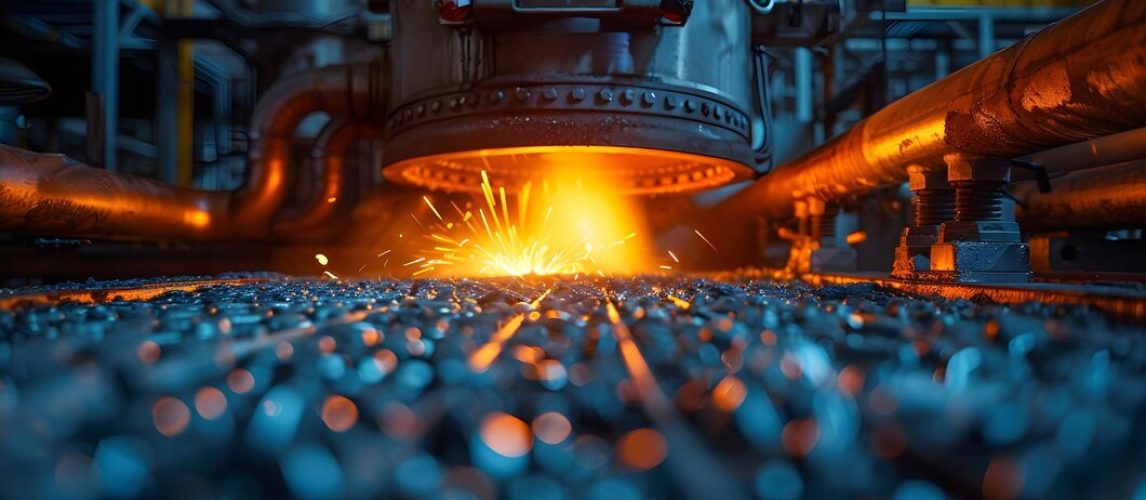
Plasma Gasification
Plasma gasification involves the utilization of plasma energy to convert material to syngas; plasma can be thought of as a fourth state of matter, and much like fire or electricity, this energy can be used in a variety of applications. Plasma can be formed by passing an electric charge though gas, then keeping the dissociated ions and electrons separate; the products of this process can achieve temperatures beyond 6000 °C, almost as hot as the surface of the sun. As one can imagine, this type of energy in a gasification reaction will allow for a wider range of fuel types, like biomass or municipal solid waste. These types of gasifiers are thought of as highly efficient, with minimal maintenance in an industrial setting. What is more significant is that the syngas can be produced such that virtually no tar/char products will be present (although contaminants will exist that are removed in downstream processes).
A plasma torch is used to produce heat at the bottom of the gasifier; feed is charged into the reactor through the side and the syngas leaves out of the other side. A melted compound of byproduct will form in the slag from this reaction; this valuable product will be removed from the reactor.
Diagrams

Equipment
- Plasma Torch
- Waste Trituration
- Distillation Unit
- Pyrolysis Chamber
- Quencher/Scrubber
- Turbine
No comment yet, add your voice below!