
What is Plasma?
Plasma, referred to as the “fourth state of matter,” is a very high temperature, highly ionized (electrically charged) gas capable of conducting electrical current. Examples of plasma in nature include lightning and gas at the surface of the sun. Plasma technology has a long history of development and has evolved into a valuable tool for engineers and scientists who need to use very high temperatures for new process applications. Man-made plasma is formed by passing an electrical discharge through a gas such as air or oxygen (O2). The interaction of the gas with the electric arc dissociates the gas into electrons and ions, and causes its temperature to increase significantly, often exceeding 6,000°C, nearly as hot as the sun’s surface.
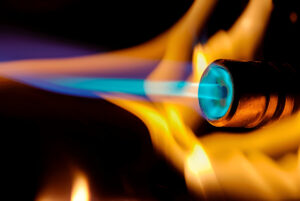
Figures 1 and 2 show a schematic drawing and a picture, respectively, of a plasma torch used to generate plasma. The plasma torch can be fed with process gases of various chemical composition including air, O2, nitrogen (N2), argon and others, allowing the process to be tailored to specific applications. These figures are from published information of AlterNRG/Westinghouse Plasma Corporation. The Westinghouse Plasma Corporation (WPC) has been developing plasma torch technology for over 30 years, and has found torches to be highly efficient devices, able to be operated with minimal maintenance in an industrial environment. WPC is now offering four different plasma torch systems each designed to operate over a wide range of power inputs. AlterNRG acquired WPC as a wholly owned subsidiary in 2007.
Plasma Gasification and its Potential Advantages
WPC has been developing plasma gasification technology to treat industrial and municipal solid wastes (MSW) over the last decade, and recently has been investigating the application of their plasma technology to gasify coal. They believe their technology can be demonstrated to gasify coal in an ambient pressure, plasma-fired reactor that can be retrofitted into existing power plants and/or installed as a new facility, with the following potential benefits over a pulverized coal power and/or conventional gasification plant:
- Greater feed flexibility enabling coal, coal fines, mining waste, lignite, and other opportunity fuels (e.g., biomass and MSW) to be used as fuel without the need for pulverizing
- Air blown and thus an oxygen plant is not required
- High availability (>90%)
- High conversion (>99%) organic matter to synthesis gas (syngas)
- No tar in syngas; syngas of approximately 140 Btu/scf for air-blown design suitable for syngas combustion turbine operation after gas cleanup
- No char, ash or residual carbon; only producing a glassy slag with beneficial value
- Compliant with EPA New Source emissions standards for nitrogen oxide (NOx), sulfur oxide (SOx) particulates, etc.
- Higher thermal efficiency
- Lower carbon dioxide (CO2) emissions
- Low estimated capital and operations and maintenance (O&M) costs
According to WPC’s estimation, only 2 to 5% of the total energy input into their gasification system is consumed by the plasma torch, and that 80% of the total energy input in the feed can be recovered in the produced syngas.
Figure 3 shows a drawing of the WPC plasma gasifier. The gasifier is heated by a plasma torch system located near the bottom of the reactor vessel. In the gasifier, the organic feed (e.g., coal, MSW, auto shredder residue, biomass, etc.) is charged into the vertical reactor vessel at atmospheric pressure. The gasifier is either refractory lined or water cooled on the outside, in which case the refractory is used only in the lower melting zone. A superheated blast of air, which may be enriched with oxygen, is provided to the bottom of the gasifier, at the stoichiometric amount required for gasification. The amount of air fed is such that the superficial velocity of the upward flowing gas is low, and that the unbriquetted/ pulverized feed materials can be fed directly into the reactor. Additional air and/or steam can be provided at different levels of the gasifier to assist with pyrolysis and gasification. The temperature of the syngas leaving the top of the gasifier is maintained above 1,000°C. At this temperature, tar formation is eliminated.
Gasification takes place at very high temperatures, driven by the plasma torch system, which is located at the bottom of the gasifier vessel. The high operating temperatures break down the coal and/or all hazardous and toxic components into their elemental constituents, and dramatically increase the kinetics of the various reactions occurring in the gasification zone, converting all organic materials into hydrogen (H2) and carbon monoxide (CO). Any residual materials of inorganics and heavy metals will be melted and produced as a vitrified slag which is highly resistant to leaching.
Commercial Development
WPC, as a former business unit of Westinghouse Electric Corporation, has spent over 30 years in research and development of plasma technology, of which the efforts spent over the last decade were on plasma gasification systems to treat industrial and municipal solid wastes. Application to coal gasification represents a relatively new venture. WPC developed three demonstration/commercial projects with Hitachi Ltd., Japan using plasma gasification technology. Other developments include projects in India and Turkey involving plasma gasification of hazardous waste to power, and several projects in the United States involving MSW and coal gasification.
Other plasma MSW gasification developers include Plasco Energy Group Inc. of Canada, PEAT International of Taiwan, and Advanced Plasma Power of England.
Hitachi MSW Gasification Demonstration Plant, Yoshii, Japan
A MSW plant, based on WPC’s plasma gasification technology, was constructed and commissioned in 1999, by Hitachi Ltd., at Yoshii, Japan. The project was developed as a solution to the dioxin, ash and energy recovery problems from many incineration waste-to-energy plants in Japan. The plant processes 24 tons per day (tpd) of MSW and produces steam for industrial usage. Reported results have been very positive. Emissions are very much reduced and the produced slag is a glassy product with value as a construction material. Dioxins were measured at levels approximately 100 times lower than from an incineration plant. Operations are said to be very reliable and the Japanese government subsequently certified its design for the construction of a small commercial size at Utashinai, Japan.
Hitachi MSW Gasification Plant, Utashinai, Japan
Figure 4 shows a picture of the plant. It was completed in 2002, and fully operational in 2003. The original design of the plant factored in a capacity of around 170 tons per day of MSW and automobile shredder residue, generating syngas which is used to generate power and process steam. In 2007 the plant processed approximately 300 tons per day, generating up to 7.9 megawatt-hours (MWh) of electricity, selling about 4.3 MWh back to the power grid. Although successful, the plant is said to have been closed by 2013, not because of any technical issues, but because increasing recycling of MSW in Japan eliminated sufficient feedstock for the plant’s operation.
Hitachi Combined MSW and Sewage Sludge Gasification Plant, Mihama and Mikata, Japan
This MSW commercial plant was also built and commissioned in 2002, to treat 24 tpd of MSW and 4 tpd of sewage sludge. The energy generated is used in a municipal waste water treatment facility.
Gasifier
Gasification Introduction
Gasification is a technological process that can convert any carbonaceous (carbon-based) raw material such as coal into fuel gas, also known as synthesis gas (syngas for short). Gasification occurs in a gasifier, generally a high temperature/pressure vessel where oxygen (or air) and steam are directly contacted with the coal or other feed material causing a series of chemical reactions to occur that convert the feed to syngas and ash/slag (mineral residues). Syngas is so called because of its history as an intermediate in the production of synthetic natural gas. Composed primarily of the colorless, odorless, highly flammable gases carbon monoxide (CO) and hydrogen (H2), syngas has a variety of uses. The syngas can be further converted (or shifted) to nothing but hydrogen and carbon dioxide (CO2) by adding steam and reacting over a catalyst in a water-gas-shift reactor. When hydrogen is burned, it creates nothing but heat and water, resulting in the ability to create electricity with no carbon dioxide in the exhaust gases. Furthermore, hydrogen made from coal or other solid fuels can be used to refine oil, or to make products such as ammonia and fertilizer. More importantly, hydrogen enriched syngas can be used to make gasoline and diesel fuel. Polygeneration plants that produce multiple products are uniquely possible with gasification technologies. Carbon dioxide can be efficiently captured from syngas, preventing its greenhouse gas emission to the atmosphere and enabling its utilization (such as for Enhanced Oil Recovery) or safe storage.
Gasification offers an alternative to more established ways of converting feedstocks like coal, biomass, and some waste streams into electricity and other useful products. The advantages of gasification in specific applications and conditions, particularly in clean generation of electricity from coal, may make it an increasingly important part of the world’s energy and industrial markets. The stable price and abundant supply of coal throughout the world makes it the main feedstock option for gasification technologies going forward. The technology’s placement markets with respect to many techno-economic and political factors, including costs, reliability, availability and maintainability (RAM), environmental considerations, efficiency, feedstock and product flexibility, national energy security, public and government perception and policy, and infrastructure will determine whether or not gasification realizes its full market potential.
The graphic below is a representation of a gasification process for coal, depicting both the feedstock flexibility inherent in gasification, as well as the wide range of products and usefulness of gasification technology.

Commercial Gasifiers
Types of Gasifiers
Although there are various types of gasifers (gasification reactors), different in design and operational characteristics, there are three main gasifier classifications into which most of the commercially available gasifiers fall. These categories are as follows:
- Fixed-bed gasifiers (also referred as moving-bed gasifiers)
- Entrained-flow gasifiers
- Fluidized-bed gasifiers
Commercial gasifiers of GE Energy, CB&I E-Gas™ and Shell SCGP are examples of entrained-flow types. Fixed-or moving-bed gasifiers include that of Lurgi and British Gas Lurgi (BGL). Examples of fluidized-bed gasifiers include the catalytic gasifier technology being commercialized by Great Point Energy, the Winkler gasifier, and the KBR transport gasifiers. For more specific information on these gasifiers and others, follow the links for the bulleted gasifier types above.
NOTE: Although specific gasifiers named above are described in detail throughout this website, it is realized that other gasification technologies exist. The gasifiers discussed herein were not preferentially chosen by NETL.